The advent of AI is either exhilarating or terrifying, depending on the day and maybe your last interaction with Siri. That’s because the stakes of the technology, at least as it’s promoted by its developers, is really really high. If what they say about it is true, it could upend human work as we know it. No wonder, then, that a crisis of trust has accompanied its rapid rise.
What happens when you take AI into rooms where the stakes are high and the tolerance for error is low? Rooms like courtrooms. Or patrol cars. My guests on this edition of Out to Lunch Acadiana are both building AI products for exactly those environments. And what they’ve each discovered is that the technology is almost never the hardest part. The hardest part is trust.
Grant Schexnailder grew up in Lafayette — out near Milton — and comes from a family of entrepreneurs. His mom runs Cheers Cheerleading Academy. Both of his grandfathers ran their own businesses. Grant went to LSU for finance, then to Southern University for law school — a calculated decision, he’ll tell you, more than a calling.
By day, Grant defends municipalities and government agencies against litigation. Which means he knows courtrooms. He knows juries. And he knows how much rides on who ends up in that box.

Grant Schexnailder, Co-Founder of Empath Legal, using AI to help courtroom laywers select jurors
When ChatGPT arrived, Grant saw something. Jury selection — one of the most consequential and least scientific parts of a trial — was a problem AI could help solve. In 2024, he co-founded Empath Legal with software engineer Shane Zhang. Empath is an AI-powered jury insight platform that aggregates public records and social media data to give litigators objective information about prospective jurors.
Sarah Brasseaux is developing AI tools a little further up the criminal justice chain. She’s Co-Founder of Blue Partner, an AI platform for law enforcement agencies.

Sarah Brasseaux, Co-Founder of Blue Partner, using AI to save time, helping law enforcement officers write reports that can otherwise take up to 50% of their shift
Sarah graduated from UL with a degree in General Studies, and she’ll be the first to tell you she has no law enforcement background whatsoever. Her co-founder Ryan Bourque does, however. He’s the IT Director for the district court in St. Martin Parish. Over the years he read enough police reports to see a pattern. When AI started becoming practical, he thought it could change how officers work in the field. Together, they founded Blue Partner in 2023, with mentorship from Lafayette’s Opportunity Machine.
Blue Partner provides cloud-based AI tools for law enforcement agencies — a hands-free chat that gives officers real-time information on a call, a voice-controlled mapping feature, and a reporting tool that helps officers write in their own words while keeping their reports court-admissible. They’re currently working with the St. Martinville and Duson police departments.
Sarah grew up in Wisconsin, moved to Texas at twelve, worked as a teacher, before relocating to Lafayette where she lives today.

Christiaan Mader hosts Out to Lunch at Tsunami Sushi in downtown Lafayette
Out to Lunch Acadiana was recorded live over lunch at Tsunami Sushi in downtown Lafayette. Photos by Astor Morgan.
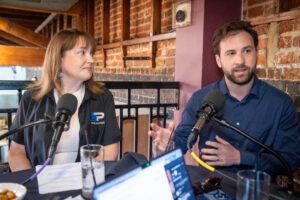
Sarah Brasseaux, Co-Founder of Blue Partner and Grant Schexnailder, Co-Founder of Empath Legal, Out to Lunch at Tsunami Sushi